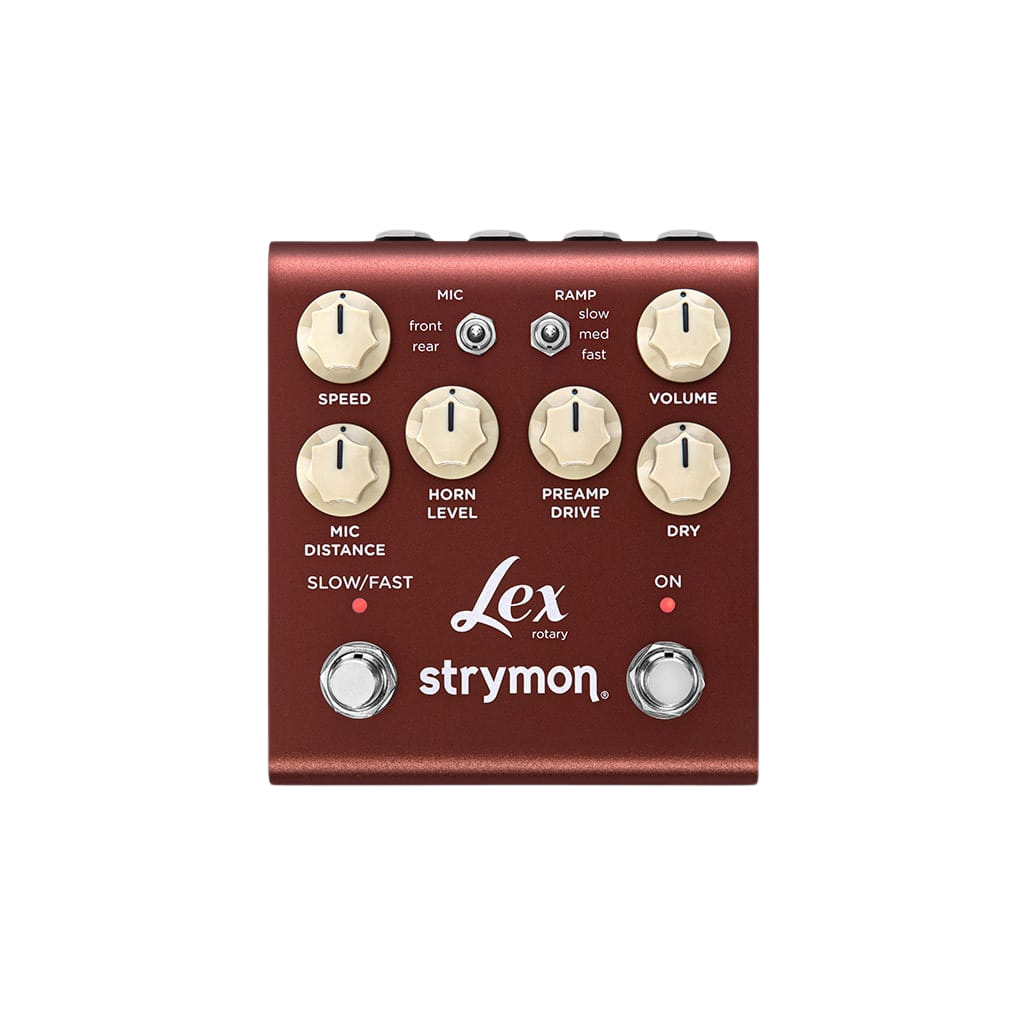
Rotary
A rotary guitar effect emulates the sound of a rotating speaker cabinet, most famously associated with vintage Leslie units originally designed for organs. As the speaker spins, it creates a complex combination of pitch modulation (Doppler effect), volume modulation, and natural phase shifting. The result is a swirling, three-dimensional guitar tone that moves and breathes in a way standard chorus or vibrato effects cannot fully replicate.
Rotary effects typically offer controls for slow and fast rotation speeds, allowing guitarists to shift from subtle, shimmering movement to dramatic, pulsing modulation. At slower speeds, a rotary effect adds gentle motion and depth to clean or lightly overdriven tones. At faster speeds, it produces an expressive, almost vocal-like warble that can cut through a mix. Many modern rotary pedals also include ramp controls, which mimic the acceleration and deceleration of real rotating speakers when switching speeds.
Guitarists commonly use rotary effects in rock, blues, gospel, psychedelic, and jam-oriented styles, where movement and texture are as important as gain. Unlike standard modulation pedals, rotary effects interact strongly with amp distortion and playing dynamics, making them especially effective placed before or after overdrive depending on the desired character. For players seeking classic motion, spatial depth, and vintage-inspired modulation, a rotary guitar effect delivers a uniquely immersive sound that remains timeless and musical.