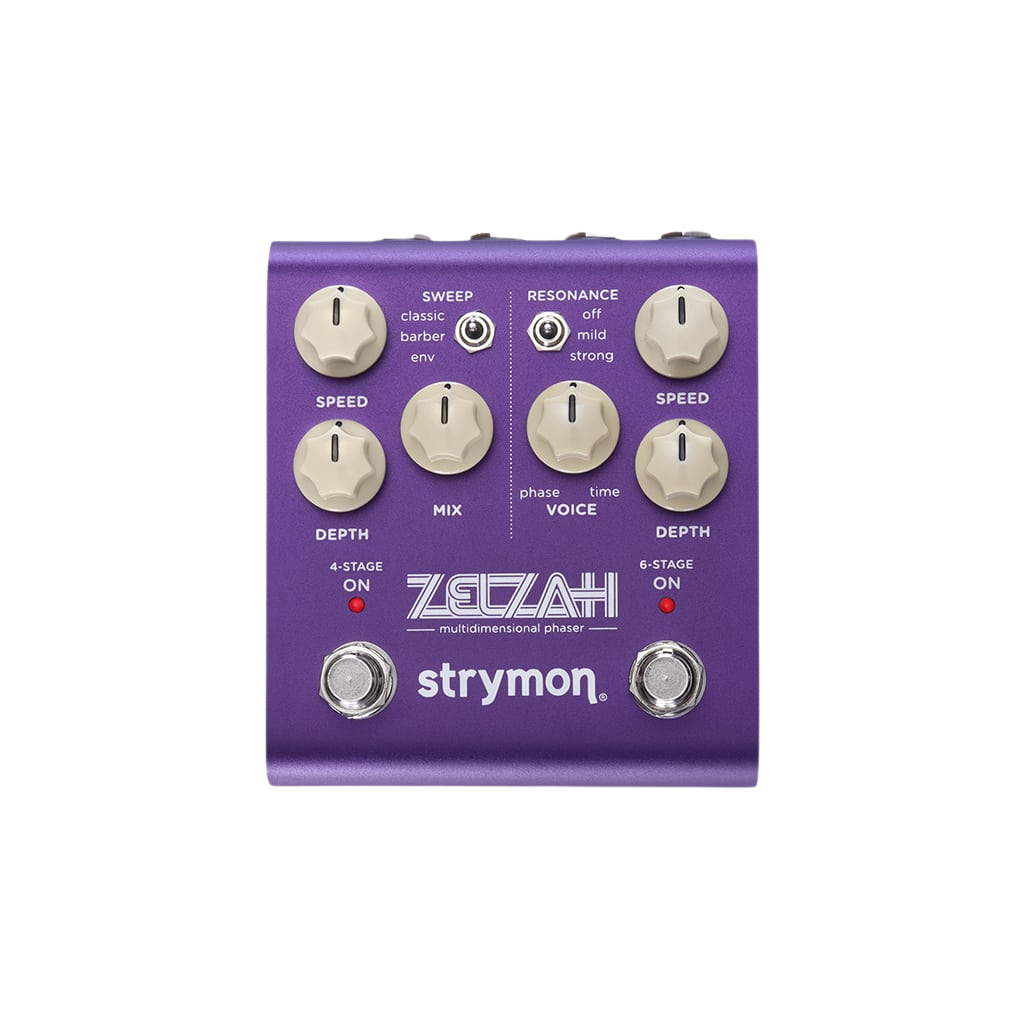
Phaser
A phaser guitar effect creates movement and depth by splitting the guitar signal and shifting the phase of one path before recombining it with the original. This process produces a series of moving peaks and notches in the frequency spectrum, resulting in a smooth, swirling sound that evolves over time. Unlike chorus or flanger effects, phasers do not rely on delay lines, giving them a more subtle and organic character.
Phaser pedals typically include controls for rate and depth, with some models offering additional parameters such as feedback, number of stages, or waveform shaping. At slower speeds, a phaser adds gentle motion and warmth to clean or lightly overdriven tones. Faster settings create more pronounced, pulsing sweeps that are instantly recognizable in funk, psychedelic rock, and classic rock recordings. Because phasers respond well to playing dynamics and gain, they often sound richer when paired with overdrive or distortion.
Guitarists use phaser effects to add texture and movement without overpowering the core tone. They work well on rhythm parts, sustained leads, and even bass guitar, depending on the settings. Whether used subtly for depth or aggressively for dramatic sweeps, the phaser remains a versatile modulation effect that adds timeless character and motion to a guitar sound.